
Greenbelt Resident Lookup Records
There is no master list behind a Greenbelt resident lookup. Every record answers a different question. Parcel ownership starts with the Maryland SDAT property search, which ties a recorded owner to a parcel once you know the address. Maryland Land Records then supplies the grantor and grantee trail behind that same parcel, showing who bought and sold it over time. The voter tools work differently. They are built around a registrant's own identifying fields. The court portal, meanwhile, offers a public case summary rather than a full file. For older people or family connections, the Archives, a probate file, and Greenbelt's local-history collections often answer a question a current database cannot.
| Record | Useful confirmation | Custodian or search | Access route |
|---|---|---|---|
| SDAT property record | Recorded owner, premises, mailing address, deed reference | Maryland SDAT | Free address, street, account, map, or sales search |
| Recorded deed | Transfer parties, legal description, prior title reference | MDLandRec | Free account; copies and certification separately |
| Voter registration | A registrant's own status, districts, and polling details | Maryland or Prince George's voter lookup | Identity fields required; not a public street browser |
| Court summary | Party role, case number, dates, claim or charge, disposition | Maryland Judiciary Case Search | Public summary; clerk holds the fuller file |
| Vital or probate record | Event facts, estate role, or historical relationship | MDH, Archives, or Orphans' Court | Eligibility and confidentiality rules vary |
| Business or license file | Public entity or professional affiliation | Business Express and Maryland Labor | Public search, but not residence proof |
An address-first property source only pays off once you hold a location. SDAT offers no owner-name search. That means a bare surname will not turn into a Greenbelt address through it. A search for an old resident instead needs a documented year, an address form, a spouse notation, or a newspaper lead. Estate questions run through the Orphans' Court or Register of Wills first, where a public filing separates an executor from an heir. Match the record type to the fact you are testing. A Greenbelt resident lookup works best that way.
Greenbelt Voter Lookup Fields
The Maryland lookup asks for a first name, last name, date of birth, and a five-digit residential ZIP before it returns anything. Street number and middle initial remain optional. The state refreshes its records daily. The Prince George's County lookup takes another route, matching date of birth plus a ZIP or a voter ID, and it posts a weekly-update notice.
One voter comes back at a time. The screenshot comes from the Maryland State Board of Elections voter lookup, a single-person tool rather than a way to browse a Greenbelt block street by street.
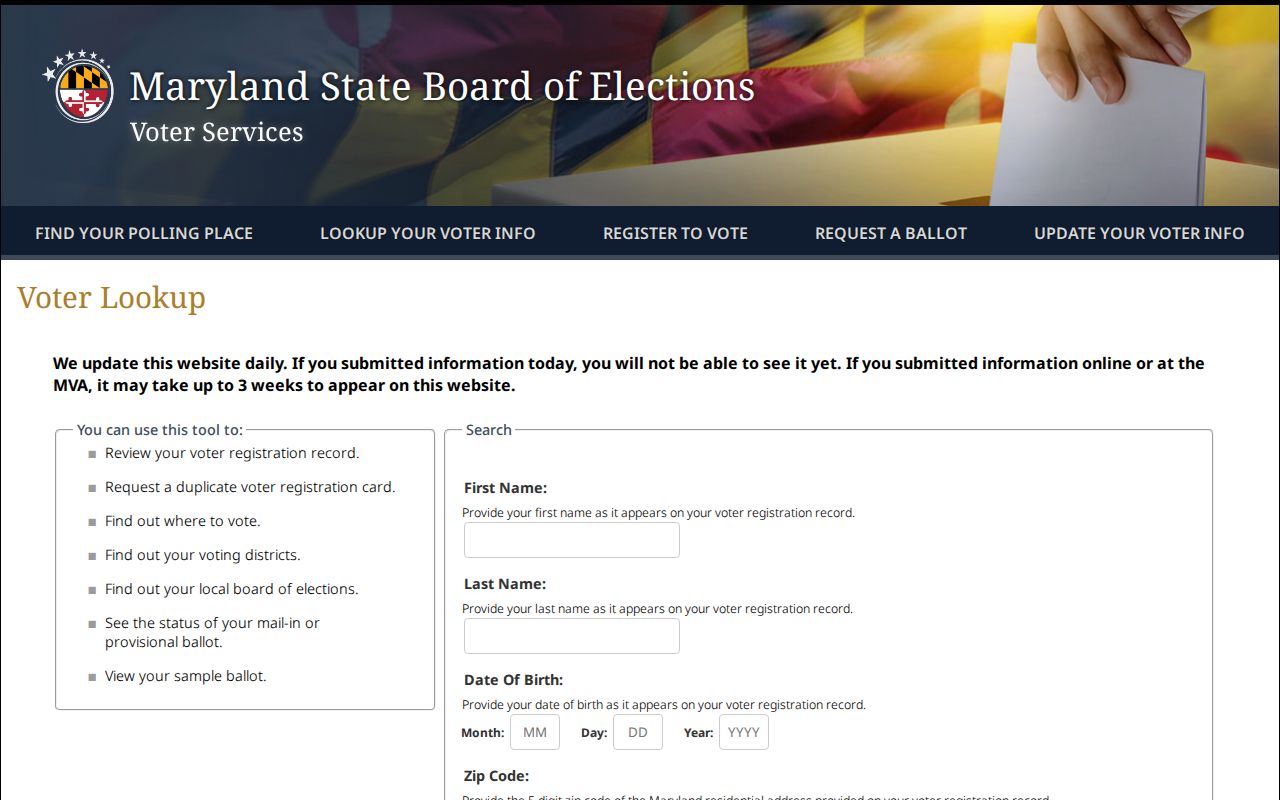
Exact identity details are the price of entry here. A Greenbelt resident lookup built on a name alone goes nowhere. The fields demand a birth date and ZIP alongside it. Residents who want a full registered-voter list must apply instead.
Maryland charges $75 for a county list. It requires a purpose statement plus a signed use certification. Buyers cannot distribute, sell, or transfer it. The list may be address-sorted for an electoral purpose. The online voter lookup stays deliberately narrower.
Greenbelt Court Result Details
The Maryland Judiciary Case Search & Record Portal lets anyone test a name against statewide case summaries. Name matching is exact by default. Add a percent sign after the first character of a last name. That widens the net. Court and case-type filters help sort people who share a name. What a public result shows is fairly rich. You get a party role, a city or state, the case number, filing or hearing dates, the case type, the charge or claim, and a brief disposition or decision line.
Maryland moved to this integrated portal on March 14, 2026. Public access continued through the transition, though the interface and some fields changed shape. Treat any returned record as a summary. It is not the full case file. For a specific filing, bring the case number to the Prince George's Circuit Court Clerk. The right District Court location works too. Federal cases live elsewhere entirely, in PACER, not in Maryland Case Search.
| Result item | What it helps confirm |
|---|---|
| Party role | Whether a name appears as a plaintiff, defendant, petitioner, respondent, or another role. |
| Case number and court | The reference needed for a clerk-file request and the jurisdiction that holds it. |
| Dates and case type | A way to separate similar names and place the event in time. |
| Disposition summary | A brief procedural outcome, not a substitute for the file or a finding about present circumstances. |
Note: Sealed, shielded, juvenile, adoption, and other confidential matters may stay unavailable both online and at the courthouse counter.
Verify a Greenbelt Resident
A reliable resident lookup needs more than a surname. Anchor the name to a date or an address. Then check it against a second independent record. Greenbelt is a small planned community, and it is full of repeated initials and historic court-unit addresses. One name alone proves little. Compare the middle initial, any spouse notation, the listed city or state, an age or birth date where lawfully visible, and the person's role in a deed or court case. An SDAT owner line matched to the same MDLandrec legal description supports recorded ownership. Even then, ownership does not confirm who occupies the premises today.
- Record the full name, a known Greenbelt date, and any address, spouse, or business detail already in hand.
- If there is an address, search SDAT for the parcel and save the premises field, legal description, account number, and Liber/Folio reference.
- Open MDLandRec, search the recorded party with exact, contains, fuzzy, or Soundex options, and compare the deed's legal description with SDAT.
- Check Case Search with the exact name and a controlled wildcard, then compare court, party role, case number, and dates before treating a hit as the same person.
- For an event record or estate relationship, use the appropriate MDH, Archives, clerk, or Orphans' Court channel and request a certified copy only when eligible.
- Docket
- A court's running list of case events, filings, hearings, and actions. The online result can be shorter than the clerk's file.
- Index and image
- An index is a searchable list of record fields. An image is the scanned document itself, which may carry the legal description or fuller wording.
- Certified copy
- A copy issued by the custodian with official certification. It is different from a screen result or ordinary downloaded image.
Greenbelt Vital Record Routes
Vital records in Greenbelt split along two routes. The Maryland Division of Vital Records handles current certificates. For older indexes and unrestricted material, the Maryland State Archives is the place to look. Access still has limits. Under State Government Article §9-1015, a birth record stays restricted for 100 years. A death record stays restricted for 10. You can find a name in a historic index. That does not make you eligible for a current certificate.
The fees are straightforward. MDH charges $10 for a birth record or a first death copy. A marriage certificate or a divorce verification costs $12. Online orders can add processing or expedited charges, and eligible ones carry a vendor fee. Mail orders take a check or money order. One more distinction matters. A divorce decree sits with the Circuit Court that granted it. MDH only verifies the event. An estate or heir question belongs in the public probate case at Orphans' Court. Skip the guesses drawn from a vital index.
For family history, Greenbelt offers strong local tools. The Tugwell Room, the News Review archive, obituary files, and the Archives can sharpen an older search. None of them waives the eligibility, identity, and record-specific rules that govern a current certificate.
Greenbelt Same-Name Checks
A same-name mix-up is the biggest hazard in any resident lookup. Early Greenbelt records often list a GHI court and unit. A street number would now appear there instead. OCR in the local newspaper archive can garble an initial or a surname too. Work the Greenbelt News Review one name, one court-unit form, and one year at a time. It works well for tracing a former classmate or a historic household. Always open the underlying page instead of trusting the OCR hit.
For a person tied to a business, Maryland Business Express lets you compare an entity's Department ID, filing date, resident agent, and principal office. Remember what a resident agent is. The role is an official service-of-process contact. It is not proof of ownership or of living in Greenbelt. A Maryland professional license query can back up a public affiliation the same way, but it will not yield a home address. Keep notes with each result: the access date, the exact spelling, the record's role, and any uncertainty you could not resolve.
Greenbelt Resident Record Requests
An online result can come up short. Ask the custodian directly for an existing, identified record. The Greenbelt MPIA portal takes requests and lets visitors review records released earlier. The Maryland Public Information Act is General Provisions Article Title 4. It governs both state and local requests. Agencies normally respond within 30 days. The first two hours of search or preparation are free. Reasonable copy or search fees can follow, though. An agency will not build a list for you or run an identity investigation.
A focused request beats a broad one. Give a date range and an address or case number. Name the record type and the office most likely to hold it. City records go through the city custodian. Court documents belong with the clerk. Current vital products sit with MDH. Historic land, probate, church, and vital research may call for an Archives reference request. The same research may call for an in-person library visit. Asking for every record about a name is the weaker approach.
Greenbelt Resident Lookup Limits
Public records have firm boundaries. Utility, delivery, and motor-vehicle customer addresses are not public resident-search channels. A property owner's tax-mailing address may differ from the premises. A court party may not live in Greenbelt at all. Maryland's Safe at Home Address Confidentiality Program gives eligible survivors and threatened people a substitute address. The program forwards mail to that substitute address. Protected voter addresses, sealed or shielded case material, and court withholding rules must stay protected.
Commercial people-finder compilations blend broker data with public information. They can be stale, incomplete, or tied to the wrong person entirely. The official custodian remains the verification source. MODPA rights bind covered businesses. But they do not erase a public deed or court record from its custodian. Spot an error? Document the exact field. Then contact the office that created the record rather than treating a third-party result as authoritative.
Lawful use. Use a Greenbelt resident lookup for personal research, family history, civic questions, or a documented record issue. Maryland law prohibits stalking and harassment; never use record details to watch, threaten, or intimidate anyone.